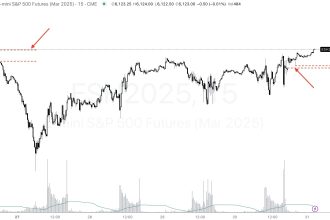
In technical analysis, a false breakout refers to a situation where price appears to breach a key technical level (such as support/resistance levels, trendlines, or trading ranges) but quickly reverses and returns to its original trend or range. False breakouts mislead traders into making incorrect decisions (e.g., chasing gains or panic selling), making the identification and avoidance of such signals a critical aspect of technical analysis.
Core Characteristics of False Breakouts
- Short-lived breach of key levels:
- Price briefly crosses a support/resistance level or trendline but fails to sustain the breakout (e.g., closing prices do not hold above/below the level).
- Example: A stock surges above a long-term resistance level but gaps down below it the next day.
- Lack of volume confirmation:
- The breakout is not accompanied by a significant increase in trading volume, or volume even declines, indicating weak market participation and a potential “false signal.”
- Rapid reversal:
- After the breakout, price quickly retrace back into the original range, creating a “bull trap” (false upside breakout) or “bear trap” (false downside breakout).
- Common in specific market conditions:
- Low-volatility environments (e.g., late-stage range-bound markets), low-liquidity periods (e.g., around holidays), or during institutional manipulation.
Main Types of False Breakouts
False breakouts can be categorized by direction and market structure:
1. False Upside Breakout (Bull Trap)
- Appearance: Price briefly breaks above a resistance level or range top, seemingly initiating an uptrend, but then reverses downward.
- Typical scenarios:
- Institutional traders push prices higher with small buy orders to attract retail investors, then sell off (“pump and dump”).
- The market is at the top of a trading range, and the breakout lacks fundamental support.
2. False Downside Breakout (Bear Trap)
- Appearance: Price briefly breaks below a support level or range bottom, seemingly initiating a downtrend, but then rebounds upward.
- Typical scenarios:
- Institutional traders drive prices lower with small sell orders to trigger stop-losses, then buy back (“bear raid”).
- The market is at the bottom of a trading range, and the breakout is driven by panic selling.
3. False Trendline Breakout
- Appearance: Price briefly breaches an uptrend line or downtrend line but does not reverse the primary trend.
- Example: In an uptrend, price dips below a short-term uptrend line but quickly rebounds to continue the long-term rally.
Causes of False Breakouts
- Market manipulation:
- Large institutional players create fake breakouts to trick retail traders into following, then profit from the opposite move (e.g., “washing out” positions or baiting traps).
- Liquidity traps:
- In low-liquidity markets (e.g., small-cap stocks, exotic forex pairs), minor trades can trigger breakout signals, but lack follow-through buying/selling.
- Emotional trading:
- Retail traders pile into trades out of fear or greed (e.g., chasing breakouts), causing temporary price distortions.
- Lagging technical indicators:
- Relying solely on lagging indicators (e.g., moving averages) without confirming with price action and volume.
- Disconnect between technicals and fundamentals:
- Breakouts lack fundamental justification (e.g., earnings, policy changes), making them unsustainable.
Technical Methods to Identify False Breakouts
1. Validation of Breakout Validity
- Closing price rule:
- Price must close above/below the key level for multiple consecutive periods (e.g., 2–3 candlesticks) to confirm a valid breakout.
- Example: For an upside breakout, the daily close must hold above resistance, not just intraday spikes.
- Volume confirmation:
- Valid breakouts are usually accompanied by a significant volume increase (e.g., +30% vs. prior periods). False breakouts show weak or abnormal volume.
2. Price Action Analysis
- Reversal candlestick patterns:
- Bearish patterns (e.g., shooting star, evening star) after an upside breakout or bullish patterns (e.g., hammer, morning star) after a downside breakout signal potential false breakouts.
- Gap theory:
- Gaps formed during breakouts that are quickly filled (e.g., “common gaps”) often indicate false breakouts, while persistent gaps (with trend continuation) signal true breakouts.
3. Multi-Timeframe Analysis
- Prioritize higher timeframes:
- Breakouts on weekly/daily charts carry more weight than those on hourly charts, which may be noisy.
- Cross-timeframe validation:
- Example: A daily breakout above resistance but a weekly chart still in a range warns of potential false signals.
4. Technical Indicator Confirmation
- Momentum indicators:
- Divergence in RSI or MACD (e.g., price makes a new high but RSI does not) suggests weak breakout momentum.
- Volatility indicators:
- ATR (Average True Range) showing no significant volatility expansion around the breakout may indicate invalidity.
5. Market Structure Testing
- Second retest of key levels:
- After a breakout, price retests the broken support/resistance (now acting as new support/resistance). A valid breakout holds at this level, while a false breakout breaches it.
Trading Strategies for False Breakouts
1. Wait for Confirmation
- Strategy: Avoid entering trades at the initial breakout; instead, wait for price to sustain the move or show reversal signals.
- Example: For an upside breakout, wait for a confirmed close + a follow-up bullish candlestick with strong volume.
2. Fade the False Breakout (Mean Reversion)
- Strategy: Once a false breakout is confirmed, take a counter-trend position (e.g., short after a bull trap, long after a bear trap).
- Entry points:
- Bull trap: Short when price drops below the resistance level with bearish candlestick confirmation (e.g., bearish engulfing).
- Bear trap: Long when price rebounds above the support level with bullish candlestick confirmation (e.g., bullish engulfing).
3. Risk Management
- Stop-loss placement:
- For breakout trades, place stops just beyond the breakout level (e.g., below resistance for upside breakouts).
- For fade trades, place stops beyond the false breakout’s extreme (e.g., above the bull trap’s high).
- Position sizing:
- Use smaller position sizes (e.g., 1–2% of capital) for high-risk breakout trades to limit losses from false signals.
4. Avoid High-Risk Periods
- Steer clear of trading breakouts during:
- Holidays (low liquidity), pre-major news releases (unpredictable volatility), or late-stage range-bound markets (indecisive direction).
Key Differences: True Breakout vs. False Breakout

Conclusion
False breakouts are common “traps” in technical analysis, reflecting temporary imbalances in market sentiment or institutional manipulation. Traders must use multi-factor validation (price action, volume, timeframes, indicators) and patience to avoid false signals. Remember: Genuine trend breakouts are supported by market consensus and sustained capital flow, while false breakouts are often fleeting tricks driven by emotion or manipulation. Prioritizing risk management, using proper position sizing, and integrating fundamental context are key to navigating these challenges.
Interpretations of other chart patterns are available in chart patterns