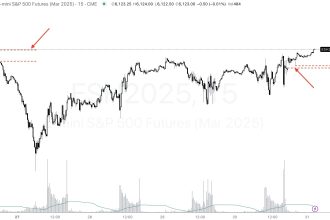
In technical analysis, a trend refers to the general direction of a security’s price movement over a specific period. Identifying trends is fundamental to technical analysis, as it helps traders and investors determine whether to buy, sell, or stay neutral based on the prevailing market momentum. Trends can be categorized into three main types, each with distinct characteristics and implications:
1. Uptrend (Bullish Trend)
An uptrend is defined by a series of higher swing highs and higher swing lows. In other words, the price consistently makes new peaks while avoiding sustained declines below previous troughs. This reflects overall buying pressure and bullish sentiment in the market.
- Key Features:
- Each successive high is higher than the previous high.
- Each successive low is higher than the previous low.
- Traders often look for buying opportunities during pullbacks to support levels (the “higher lows”) within the uptrend.
- Example: A stock rising from $50 to $60, pulling back to $55 (higher low), then rising to $70 (new high), and so on.
2. Downtrend (Bearish Trend)
A downtrend is characterized by a series of lower swing lows and lower swing highs. The price consistently makes new lows while failing to break above previous peaks, indicating selling pressure and bearish sentiment.
- Key Features:
- Each successive low is lower than the previous low.
- Each successive high is lower than the previous high.
- Traders may look for short – selling opportunities during rallies to resistance levels (the “lower highs”) within the downtrend.
- Example: A stock falling from $80 to $70, rallying to $75 (lower high), then falling to $65 (new low), and so on.
3. Sideways Trend (Rangebound/Chop)
A sideways trend (also called a “consolidation” or “range” trend) occurs when the price moves within a defined horizontal range, with neither higher highs nor lower lows. This indicates a balance between buying and selling pressure, often preceding a potential breakout or breakdown.
- Key Features:
- Price fluctuates between a support level (lower boundary) and a resistance level (upper boundary).
- Traders may use range – trading strategies, buying near support and selling near resistance.
- Example: A stock trading between $40 (support) and $50 (resistance) for several weeks, with no clear directional momentum.
How to Identify Trends
Traders use various tools and techniques to identify and confirm trends:
1. Price Charts
- Line Charts: Simplest way to visualize the overall direction of price.
- Candlestick/Bar Charts: Show open, high, low, and close prices, making it easier to identify swing highs/lows and trend structure.
- Example: On a daily chart, an uptrend will show a series of ascending candlesticks with higher highs/lows.
2. Trendlines
- Uptrend Line: Drawn by connecting two or more higher lows; acts as dynamic support.
- Downtrend Line: Drawn by connecting two or more lower highs; acts as dynamic resistance.
- Breakout: A decisive close above/below a trendline may signal a trend reversal or acceleration.
3. Moving Averages (MAs)
- Simple Moving Average (SMA): Smooths price data to identify the trend direction.
- Uptrend Sign: Price trades above a rising MA (e.g., 50 – day or 200 – day MA).
- Downtrend Sign: Price trades below a falling MA.
- Exponential Moving Average (EMA): Places more weight on recent prices, making it more responsive to trend changes.
4. Oscillators
- Relative Strength Index (RSI) or Moving Average Convergence Divergence (MACD): Help confirm trend strength or potential reversals.
- In an uptrend, RSI often stays above 50 and may reach overbought levels (70+).
- In a downtrend, RSI stays below 50 and may hit oversold levels (30 -).
5. Volume Analysis
- Rising volume during an uptrend confirms bullish momentum; rising volume in a downtrend confirms bearish momentum.
- Diverging volume (e.g., price rising on low volume) may signal a weak trend.
Why Trends Matter in Trading
- Directional Bias: Trends provide a framework for trading decisions (e.g., “buy the dips” in an uptrend, “sell the rallies” in a downtrend).
- Risk Management: Traders can align positions with the trend to reduce exposure to countertrend volatility.
- Breakout Trading: Identifying trends helps traders anticipate potential breakouts from consolidation phases (e.g., a sideways trend resolving into a new uptrend or downtrend).
Trend Reversals vs. Trend Corrections
- Reversal: A change in the trend’s direction (e.g., uptrend to downtrend). Signaled by breakdowns below uptrend lines, bearish chart patterns (e.g., head and shoulders), or momentum divergences.
- Correction: A temporary retracement against the trend (e.g., a pullback in an uptrend or a rally in a downtrend). The trend remains intact unless key support/resistance levels are breached.
By mastering trend analysis, traders can better navigate market dynamics and align their strategies with the dominant market sentiment. Remember that no trend lasts forever, and combining trend analysis with other technical tools (e.g., support/resistance, volume, and momentum indicators) can improve the accuracy of trend – based decisions.