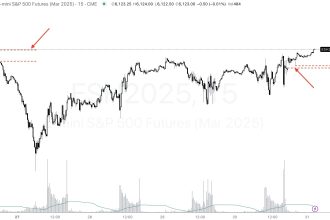
In technical analysis, a gap refers to a price range where no trading occurs between two consecutive periods (e.g., between the close of one session and the open of the next). (https://www.fin-technicalanalysis.com/2025/05/18/gaps-and-gap-analysis-in-technical-analysis/)Gaps are important because they reflect sudden shifts in market sentiment, supply, or demand, and they can provide valuable insights into trend strength, potential reversals, or continuation patterns. Below’s a detailed breakdown of why gaps matter and how they’re used:
1. Gaps Reflect Market Psychology
Gaps occur when there’s a disruption in the normal price continuity, often driven by:
- News events (earnings reports, economic data, geopolitical updates).
- Surprise announcements (mergers, dividends, regulatory changes).
- Overnight sentiment shifts (e.g., after-hours trading or global market moves).
- Liquidity gaps (low trading volume leading to large price swings).
For example:
- A stock gaps up after reporting better-than-expected earnings, reflecting bullish enthusiasm.
- A currency pair gaps down after a central bank unexpectedly cuts rates, signaling bearish sentiment.
Gaps highlight imbalance between buyers and sellers, making them critical for understanding market psychology.
2. Types of Gaps and Their Significance
Gaps are categorized into four main types, each with distinct implications for traders:
A. Common Gaps (Area Gaps)
- What they are: Minor gaps that occur in sideways or choppy markets, often due to low volume or routine trading.
- Significance:
- Not reliable for trend analysis; they typically get “filled” (prices return to the gap range) quickly.
- Example: A stock gaps up by 1% on low volume during a consolidation phase, then quickly retreats.
B. Breakaway Gaps
- What they are: Gaps that occur at the start of a new trend or breakout from a consolidation pattern (e.g., triangles, rectangles).
- Significance:
- Confirm trend reversals or continuations when accompanied by high volume.
- Example:
- A stock breaks above a resistance level at $50 and gaps up to $53 on heavy volume, signaling a bullish breakout.
- A cryptocurrency gaps down below a support level at $10,000, confirming a bearish breakdown.
- Key feature: Often not filled, as they mark the start of a strong trend.
C. Runaway Gaps (Measuring Gaps)
- What they are: Gaps that occur during the middle of a strong trend, indicating rapid price movement and sustained momentum.
- Significance:
- Confirm trend strength and help estimate the trend’s potential duration.
- The distance between the breakout gap (if any) and the runaway gap can be used to project a price target (e.g., the total trend move may be twice the distance from the breakout to the runaway gap).
- Example: A stock in an uptrend gaps up from $60 to $65 after positive news, extending the rally; this gap is a runaway gap, suggesting the uptrend has further to go.
D. Exhaustion Gaps
- What they are: Gaps that occur at the end of a prolonged trend, signaling that the trend is “exhausted” and a reversal may be imminent.
- Significance:
- Warning sign of a potential trend reversal.
- Often accompanied by extremely high volume (panic buying/selling) and occur after a sharp price move.
- Example:
- A stock surges from $30 to $50 in a week, then gaps up to $55 on massive volume; this could be an exhaustion gap, followed by a reversal downward.
- A commodity gaps down after a steep decline, with volume spiking, indicating selling fatigue.
3. Gaps and Support/Resistance
- Gapped areas often act as support or resistance levels:
- Upward gaps: The upper end of the gap may act as support if the price pulls back (e.g., a gap from $50 to $55 might see $50 become support).
- Downward gaps: The lower end of the gap may act as resistance if the price rebounds (e.g., a gap from $55 to $50 might see $55 become resistance).
- Traders use these levels to set entry/exit points or stop losses. For example:
- In a bullish breakout gap, place a stop loss below the gap’s lower boundary ($50 in the example above).
4. Gap Filling: A Key Consideration
- Gap filling refers to prices returning to the range where the gap occurred. While no rule dictates that all gaps must be filled, traders monitor this behavior:
- Bullish interpretation of unfilled gaps: Suggests strong momentum (e.g., a breakaway gap in an uptrend remaining unfilled signals sustained buying pressure).
- Bearish interpretation of filled gaps: A gap filled quickly may indicate weak follow-through (e.g., a bullish gap filled shortly after formation could signal a failed breakout).
- Statistical note: Some markets (e.g., stocks) have a higher tendency to fill gaps over time, while others (e.g., forex) may leave gaps unfilled for longer.
5. How Traders Use Gaps in Strategies
A. Breakaway Gap Trading
- Entry: Enter a trade in the direction of the gap (long for upward gaps, short for downward gaps) on the first day of the gap, with confirmation from volume.
- Stop Loss: Below the gap’s lower boundary (for upward gaps) or above the upper boundary (for downward gaps).
- Target: Use the gap’s height or pattern measurements (e.g., from a breakout pattern) to set profit targets.
B. Exhaustion Gap Trading
- Entry: Enter a counter-trend trade when an exhaustion gap is identified (e.g., shorting after a bullish exhaustion gap).
- Stop Loss: Above the gap’s upper boundary (for bearish setups).
- Target: A nearby support/resistance level or previous swing high/low.
C. Gap Support/Resistance Trading
- Trade bounces off gap levels:
- Go long if price retests the lower edge of an upward gap and holds as support.
- Go short if price retests the upper edge of a downward gap and holds as resistance.
6. Limitations and Risks of Gap Analysis
- False Signals: Not all gaps lead to trend continuations or reversals; common gaps are often meaningless.
- Market Specificity: Gaps behave differently across markets (e.g., forex gaps are often due to overnight liquidity, while stocks gaps may reflect earnings news).
- Gap Filling Uncertainty: There’s no guarantee a gap will fill, so relying solely on gap theory is risky.
- Overemphasis on Gaps: Always combine gap analysis with other technical tools (e.g., trendlines, indicators, volume) for confirmation.
Conclusion
Gaps are a vital component of technical analysis because they:
- Reveal sudden shifts in market sentiment.
- Confirm breakouts, trend strength, or potential reversals.
- Provide actionable levels for support, resistance, and trade management.
By understanding the type of gap (breakaway, runaway, exhaustion, or common) and its context (e.g., volume, trend phase), traders can gain insights into market dynamics and refine their strategies. However, gaps should never be used in isolation; always validate them with broader technical and fundamental analysis to minimize risk.